2016年3月30日星期三

Stearoyl vanillylamide 58493-50-8 weight loss/ fat burner

       Stearoyl vanillylamide 58493-50-8 weight loss/ fat burner

Product Name : Stearoyl vanillylamide
CAS No. : 58493-50-8
Molecular Formula : C26H45NO3
Molecular weight : 419.64
Appearance : white or off-white powder
Function : weight loss / fat burner


2016年3月10日星期四

Breakthrough in the treatment of Sudeck's dystropy (Chronic Regional Pain Syndrome, CRPS)

Breakthrough in the treatment of Sudeck's dystropy (Chronic Regional Pain Syndrome, CRPS)

Physicians from the Institute of Neuropathic Pain in the Netherlands reported this week a breakthrough in the treatment of severe pain in Sudeck's dystrophy. Sudeck's dystrophy, or Chronic Regional Pain Syndrome (CRPS) is a severe disorder, which can arise after a fracture or distorsion. After a freacture or distorsion a severe swelling can occur, which makes the use of the hand or foot impossible. Pain is severe and very difficult to treat. 

The breakthrough has been discussed in an open access, international pain journal. Some years ago, it became clear that the cause of Sudeck is a neuro-inflammation. Physicians in the Netherlands developed a new treatment based on a natural, endogenous molecule and supplement, PeaPure. Palmitoylethanolamide is the active ingredient of this supplement. 

The mechanism of action of palmitoylethanolamide has been discovered in 1993 by the Nobel prize laureate professor Rita Levi-Montalcini. Since 1993 this compound has been explored in many clinical trials, and proved to be effective and safe. Now it appears severe pains in Sudeck's dystrophy respond well to the treatment with palmitoylethanolamide. The severe edema (swelling) also vanished after treatment. 

PeaPure thus appears to be a new, effective and safe treatment for Sudeck. 

The article has appeared in the 'Journal of Pain Research' with the title:Treatment of chronic regional pain syndrome type 1 with palmitoylethanolamide and topical ketamine cream: modulation of nonneuronal cells. 

Abstract: Chronic regional pain syndrome (CRPS) can be intractable to treat and patients sometimes suffer for many years. Therefore, new treatment strategies are needed to alleviate symptoms in CRPS patients. This case report describes a patient suffering from intractable CRPS type 1 for 13 years. Due to her swollen painful feet and left knee she is wheelchair-bound. The combination of palmitoylethanolamide and ketamine 10% cream reduced her pain by more than 50% after 1 month of treatment, and a marked reduction in swelling and skin discoloration was noticed. Furthermore, she could walk independently again and she experienced no side effects. 

Thus, palmitoylethanolamide and topical ketamine could be a combination therapy option for treating CRPS patient.


2016年2月25日星期四

Vagal afferents are not necessary for the satiety effect of the gut lipid messenger oleoylethanolamide (OEA)

Summary of "Vagal afferents are not necessary for the satiety effect of the gut lipid messenger oleoylethanolamide (OEA)."

The endogenous lipid messenger OEA inhibits eating and modulates fat metabolism supposedly through the activation of PPAR-α and vagal sensory fibers. We tested in adult male rats whether OEA stimulates fatty acid oxidation (FAO) and ketogenesis and whether it increases plasma levels of the satiating gut peptides glucagon-like peptide-1 (GLP-1) and peptide tyrosine-tyrosine (PYY). We also explored whether OEA still inhibits eating after subdiaphragmatic vagal deafferentation (SDA). We found that intraperitoneally (IP) injected OEA (10 mg/kg body weight = BW) reduced (P < 0.05) food intake mainly by increasing meal latency and that this effect was stronger in rats fed a 60% high-fat diet (HFD) than in chow-fed rats. OEA increased (P < 0.05) postprandial plasma non-esterified fatty acids and β-hydroxybutyrate (BHB) in the hepatic portal vein (HPV) and vena cava (VC) 30 min after injection, which was more pronounced in HFD- than in chow-fed rats. OEA also increased the protein expression of the key-ketogenetic enzyme, mitochondrial 3-hydroxy-3-methylglutaryl-CoA synthase, in the jejunum of HFD-fed rats, but not in the liver or duodenum of either diet group. Furthermore, OEA decreased GLP-1 and PYY concentrations (Ps < 0.05) in the HPV and VC 30 min after administration. Finally, OEA reduced food intake in SDA and sham-operated rats similarly. Our findings indicate that neither intact abdominal vagal afferents nor prandial increases in GLP-1 or PYY are necessary for the satiety effect of OEA. The enhanced FAO and ketogenesis raise the possibility of an involvement of intestinal-derived BHB in OEA's satiety effect under certain conditions.

Journal Details
This article was published in the following journal.

Name: American journal of physiology. Regulatory, integrative and comparative physiology
ISSN: 1522-1490


2016年2月18日星期四

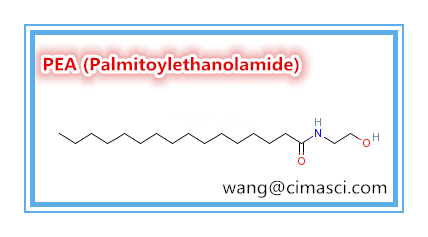
Palmitoylethanolamide (PEA) 544-31-0 anti-inflammatory supplement / pain relief

PROPERTY
Product Name : Palmitoylethanolamide (PEA) 
Chemicalformula    :     C18H37NO2
CAS NO.   :    544-31-0
Molarmass   :  299.49 g·mol1
Appearance    :  White crystals
Density    :   910 mg mL1
Meltingpoint   :59-60 °C(332-333 K)
Boilingpoint   :461.5 °C(735 K)


2016年1月24日星期日

Anti-inflammatory Effect of Palmitoylethanolamide PEA 544-31-0 on Human Adipocytes

Anti-inflammatory 
Effect of Palmitoylethanolamide on Human Adipocytes
Obesity leads to the appearance of an inflammatory process, which can be initiated even with a moderate weight gain. 

Palmitoylethanolamide (PEA) is an endogenous lipid, secreted by human adipocytes, that possesses numerous anti-inflammatory properties. 

The main purpose of this study was to investigate the anti-inflammatory effect of PEA on human adipocytes, as well as in a murine model. The production of tumor necrosis factor–α (TNF-α) by lipopolysaccharide (LPS)-treated human subcutaneous adipocytes in primary culture and CF-1 mice was investigated by enzyme-linked immunosorbent assay. The effects of PEA on adipocyte TNF-α secretion were explored as well as some suspected PEA anti-inflammatory pathways: nuclear factor–κB (NF-κB) pathway, peroxisome proliferator-activated receptor–α (PPAR-α) gene expression, and TNF-α-converting enzyme (TACE) activity. The effects of PEA on the TNF-α serum concentration in intraperitoneally LPS-treated mice were also studied. We demonstrate that the LPS induced secretion of TNF-α by human adipocytes is inhibited by PEA. This action is neither linked to a reduction in TNF-α gene transcription nor to the inhibition of TACE activity. Moreover, PPAR-α is not implicated in this anti-inflammatory activity. 

Lastly, PEA exhibits a wide-reaching anti-inflammatory action as the molecule is able to completely inhibit the strong increase in TNF-α levels in the serum of mice treated with high doses of LPS. 

In view of its virtual lack of toxicity, PEA might become a potentially interesting candidate molecule in the prevention of obesity-associated insulin resistance.


2016年1月21日星期四

PQQ (Pyrroloquinoline quinone/ Methoxatin)72909-34-3 - An Essential Micronutrient That Helps You Thrive


PQQ Pyrroloquinoline quinone/ Methoxatin72909-34-3
 - An Essential Micronutrient That Helps You Thrive
PQQ (pyrroloquinoline quinone), a novel cofactor with B vitamin like-activity and antioxidant function, provides powerful support for a wide range of functions in the body. 
The antioxidant status of PQQ is 5,000 times more potent than vitamin C. 
PQQ supplement has the potential to stimulate mitochondrial function (the primary energy source in cells) and protects from excessive oxidative damage, a major cause of rapid cell aging. 
PQQ can strongly scaveng free radicals, reduce damage from excessive stress and keep you look healthy and young.
It is a commanding nutrient with remarkable potential!


Neuroprotective activity
PQQ has been shown to optimize health and function of the entire central nervous system. It reverses cognitive impairment caused by chronic oxidative stress in pre-clinical models, improving performance on memory tests.

Mitochondrial biogenesis
Mitochondrial dysfunction has been definitively linked to virtually all killer diseases of aging, from Alzheimers disease and type 2 diabetes to heart failure. PQQ has been shown to induce mitochondrial biogenesisthe growth of new mitochondria in aging cells!

Prevention of memory loss
A randomized, double-blind study released in 2009 looked at the the effect of PQQ and CoQ10 supplementation over a 3 month period on 71 middle aged individuals.  What they found is that memory, attention, and cognition improved in individuals supplementing with PQQ and this affect was enhanced even more when taking both PQQ and CoQ10 together.

Cardiovascular health 
In a study in 2006 using animal models, PQQ was actually shown to be superior to a well known beta-blocker (metoprolol) in reducing oxidative damage after a heart attack and resulted in reduced area of cardiac tissue death and improved overall cardiac function.

Anti-oxidative activity
PQQ may be considered a super antioxidant because it is far more stable than most other antioxidants and can carry out more redox cycling reactions as a result of this.  It's been found to be 175 times more efficient than epicatechin (antioxidant found in chocolate), 200 times more efficient than quercetin (antioxidant found in green tea & various fruits & vegetables), and 5,000 times more efficient than vitamin C.


Wuxi Cima Science Co.,Ltd is an ingredients and raw materials manufacturer of herbal/botanical extracts, nutritional chemicals for the industry of food, beverage, nutraceutical, pharmaceuticals and cosmetic.


2016年1月19日星期二

micronized palmitoylethanolamide (PEA)-transpolydatin in the treatment of chronic pelvic pain

Administration of micronized 
palmitoylethanolamide(PEA)-transpolydatin 
in the treatment of chronic pelvic pain in women affected by endometriosis: preliminary results

AIM: Aim of the study was to evaluate the effectiveness of micronized palmitoylethanolamide (PEA)-transpolydatin in the treatment of chronic pelvic pain in women affected by endometriosis.; 

METHODS: Twenty-four patients with suspected endometriosis affected by severe pelvic pain were enrolled. All patients received two tablets a day of PEA 400 mg and 40 mg polydatin for 90 days consecutively. A Visual Analogic Scale was used for the assessment of the severity of global pain, dysmenorrhea, dyspareunia, dysuria and dischezia. A second questionnaire was submitted to patients to assess the quality of life. The compilation of a diary lead us to evaluate the monthly assumption of any painkillers. Patients were evaluated at the begin of the treatment and then monthly until the end of the study (90 days). The statistical analysis was performed by using the ANOVA for the analysis of variance.; 

RESULTS: Statistically significant results were found in relation to pelvic pain, dysmenorrhea and dyspareunia compared to the initial evaluation of patients. Results related to dysuria and dischezia were not statistically significant (P>0.05). The decrease in pelvic pain leads to an improvement of the quality of life of patients. A decreased assumption of nonsteroidal anti-inflammatory drugs (NSAIDs) was also observed.; 

CONCLUSION: PEA could be considered an effective supplement to conventional analgesic therapies in the management of pelvic pain related to endometriosis.

source: http://www.knowledge.scot.nhs.uk/together/search-results.aspx?q=publicid%3a%22OVIDmedl%7c24051945%22&pm=fql&expand=true